

Know Thyself
a word for young writers and an encouragement for all

by Carolyn Clare Givens
Several weeks ago, I was sitting in a lecture hall while Malcolm Guite shared about his newest project, writing a poetic Arthuriad with Rabbit Room Press, and then answered questions from the audience about various topics.
I’d just finished Hutchmoot, the Rabbit Room’s annual in-person gathering, and more than one young writer (say 18 and under) had talked to me about the next step of getting their work out into the world.
When you’re a publisher and you publish books for literary-minded young readers, this happens a lot.
Just that evening, before the lecture, I’d entered the room, and a woman I’d met swooped over to me and introduced a young poet and her dad. She was a lovely teen, and I felt like she had a good head on her shoulders about how to approach her work and what it might mean for her. Her dad played bluegrass and was a working musician in Nashville, and it sounded like they’d come to this event for her.
One of the first things I usually say to a young writer is that writing and publishing are two very different things. I want to encourage every young writer to write. I don’t want to encourage every young writer to publish. Sometimes, publishing the work is a good path for a young writer (but I’d say that’s the exceptional situation). For most young writers, I encourage patience—what you put out into the world at 15 will still be there when you’re 30…and you will have grown a lot in the meantime. Do you want to look back in 10 or 15 years and regret that everyone saw your early, sometimes foundering work?
I also find that I do a lot of educating of young writers about the systems of publishing. You can absolutely self-publish your 300,000 word novel as an ebook and print on demand. The print version of that book will be about 1,200 pages long. It will cost approximately $23.00 to print it and ship it to the customer. If you want to make any profit from it, you’ll need to set your retail book price higher than that—let’s say $25.00—that feels like a reasonably priced book, right? You are earning $2 for every book you sell, which is 8% of the retail price. Oh, don’t forget to account for any costs you incurred to publish the book: illustration or cover design, maybe layout or editorial help. The money disappears pretty quickly…and we haven’t even talked about the fact that the book is about 1,200 PAGES LONG. How many people will choose to read that?
When you add in the factor of traditional publishing, whether you’re submitting that manuscript to an agent or directly to a publishing house, you cut yourself off at the knees when you get word counts that high—or even a third that length. Most agents and editors won’t even look at a manuscript that is longer than the recommended word count for the target age and genre. You can Google those numbers easily (“recommended word count for middle grade”) and find tons of advice on the internet. The reality is that most people working in the publishing business aren’t willing to take risks on books that are outside the norm—particularly from first-time authors, and particularly from young authors with no track record.
I find that I deflate a lot of dreams when I chat with a teenage writer.
But anyway, back to that night when Malcolm Guite spoke…during the Q&A, the dad of the young poet I’d met when I walked in the door stood in line for the mic on the far side of the room. When it was his turn, he mentioned that he was accompanied by his 15-year-old daughter, a poet, and wondered if Malcolm had any advice for young writers.
Malcolm’s answer knocked my socks off, and I’ll be reworking how I talk with young writers in the future to incorporate what he had to say.
He reminded us that in writing—poetry especially, but any writing—heart calls out to heart. The heart of the writer is calling out into the world, and the heart of the reader is responding. He noted that Scripture phrases it this way: “deep calls to deep” (Ps. 42).
He encouraged the young lady to write from her depth and to work to find images that can carry the weight of it.
That phrase was the first revelation: my challenge to young writers that they will only grow in their ability is a fairly self-centered message (“You don’t want to look back and be embarrassed by what you’d published”). But Malcolm turned that around and asked the young writer to “know thyself” and to strive to find words that can carry that weight. So many of us still haven’t done the inner examination needed to know ourselves, much less to express that to others. How often has a teen done that?
Then the second idea he shared was another revelation. He said “heart speaking to heart” should not be understood as therapy. Your writing (that writing you share) is not something you do for yourself. He said, it’s finding the thing in me that is communicable. “Something particular and local and nameable that can become the symbol.”
“Be specific, but not confessional,” he said.
I’m stealing these ideas for my next conversation with a young writer. I’ll probably still educate them about the realities of publishing, but I want to tend their hearts the way I saw Malcom do—encouraging them to know themselves deeply and truly and to strive to find the words to share what is communicable of that out into the world…and to do so without being confessional.
Frankly, it’s advice we all could use, whether we’re writers or not.
I can’t wait for the next conversation.
Call for Questions!
In our final Banderpod episode of the season, we’d like to answer your questions! What do you want to know about books (our books, other books, etc.), about us (that is, Rachel, Annie Beth, and Carrie), about publishing (we are learning new things all the time!) and more? Pop your questions in comments here or email info@bandersnatchbooks.com!

November 25, 2025 - Release of Joe the Fourth and the King’s Crown, a lower middle-grade novel by Mary Barrows
November 28–December 1, 2025 - Holiday sales
December 2025 - Release of I’ve Got a Bad Case of Poetry, our illustrated children’s poetry anthology edited by Rachel S. Donahue - Preorder on the Kickstarter Platform

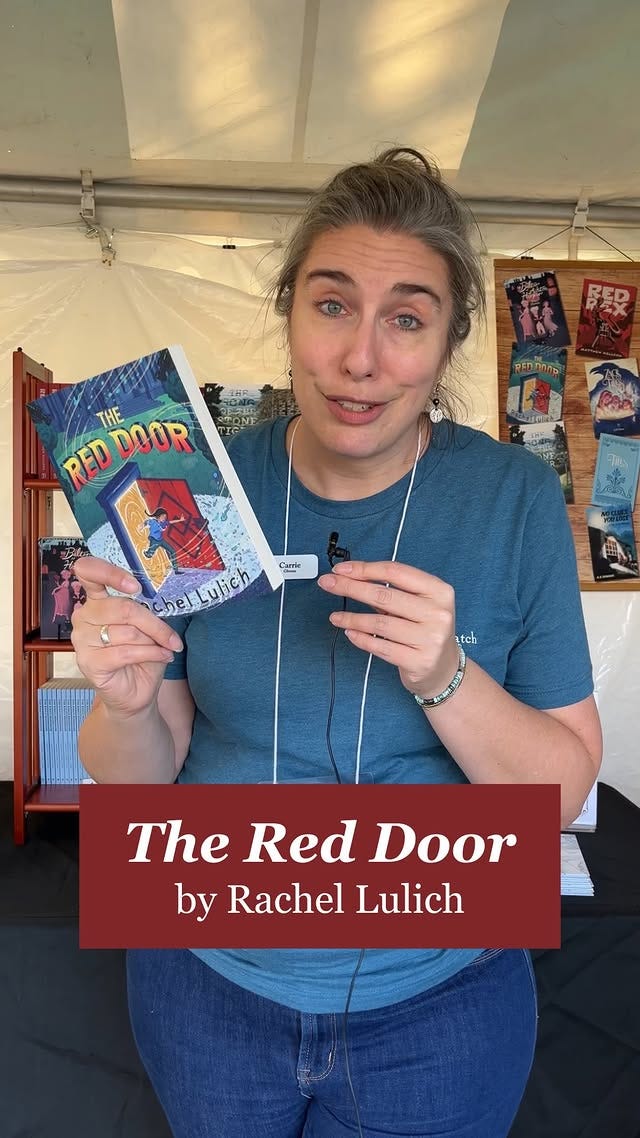
Have you read The Red Door by @rachellulich? Here’s a little introduction!
Also please follow Bandersnatch Books on Instagram or Facebook!

“Your job [as a writer] is to see people as they really are, and to do this, you have to know who you are in the most compassionate possible sense.”
–Anne Lamott, Bird by Bird

 |
|
As a young writer who is intending to publish books for the rest of her life, I have heard lots of wacky advice on writing. Sometimes I tell people I want to be a writer and they look at me like I’ve grown a third arm. Sometimes they smile and indulge me like I’m still living a childhood fantasy. Sometimes they caution me that writing is just a side hobby and that I need to get a “real” job too. But there are a precious few—and these are the people I choose to learn from in my writing education—who tell me that young writers can change the world. Young writers may not publish at 15, but they shouldn’t stop writing at 15. Young writers shouldn’t give up on their dreams because of what other people say about the impossibility of the industry. Young writers have the permission to become published, culture-influencing authors.
That’s why I’m attending the Author Conservatory. If you haven’t heard of it, you should check it out. “Dreamy, idealistic young writers” might go into the program, but serious, business-minded, skilled, knowledgeable adult writers graduate from it.
Thank you for this post. It’s a kind reminder that young writers have just as much of a chance to be amazing as do adult writers. 💜
I love all of this advice. Though not young anymore, ahem, I am still a novice writer and that advice to be specific without being confessional is something I try to do, though the line can be a tricky one to navigate. I can imagine that it is even harder for young people who are so keen. In my middle age, I find myself pivoting between two poles: one wants to get my work out into the world and the other questions whether anyone would want to publish it. I find I need to temper both viewpoints.